

The complete guide
The complete guide to vacuum forming
Vacuum forming is the most widely used thermoforming process — the economical way to turn a plastic sheet into covers, trays, liners, panels and packaging. This guide covers how it works, thin vs thick gauge, how it compares with pressure forming and injection moulding, and the design, material, tooling and finishing detail engineers need to specify a part correctly.
Heat, draw, cool, trim
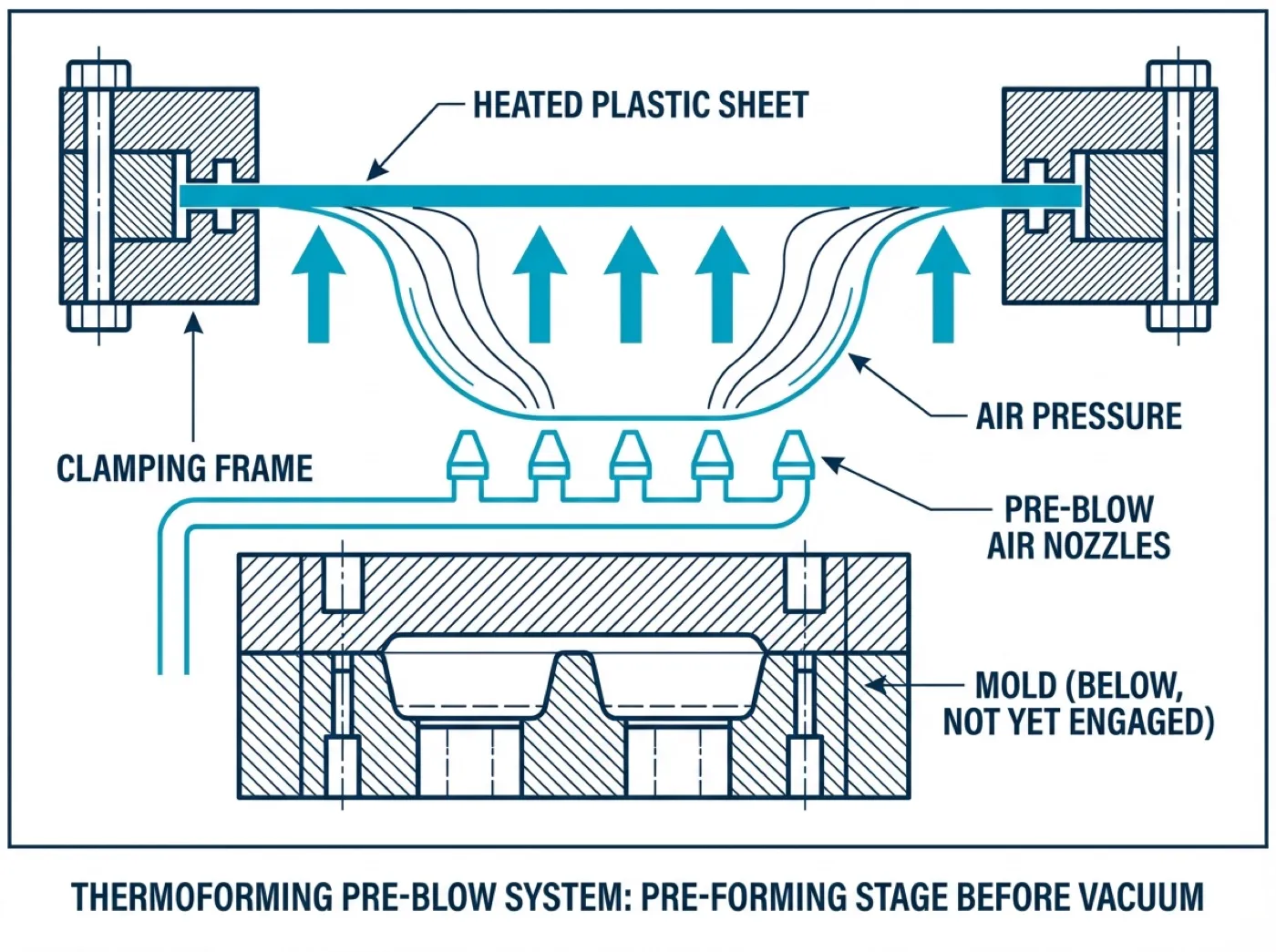
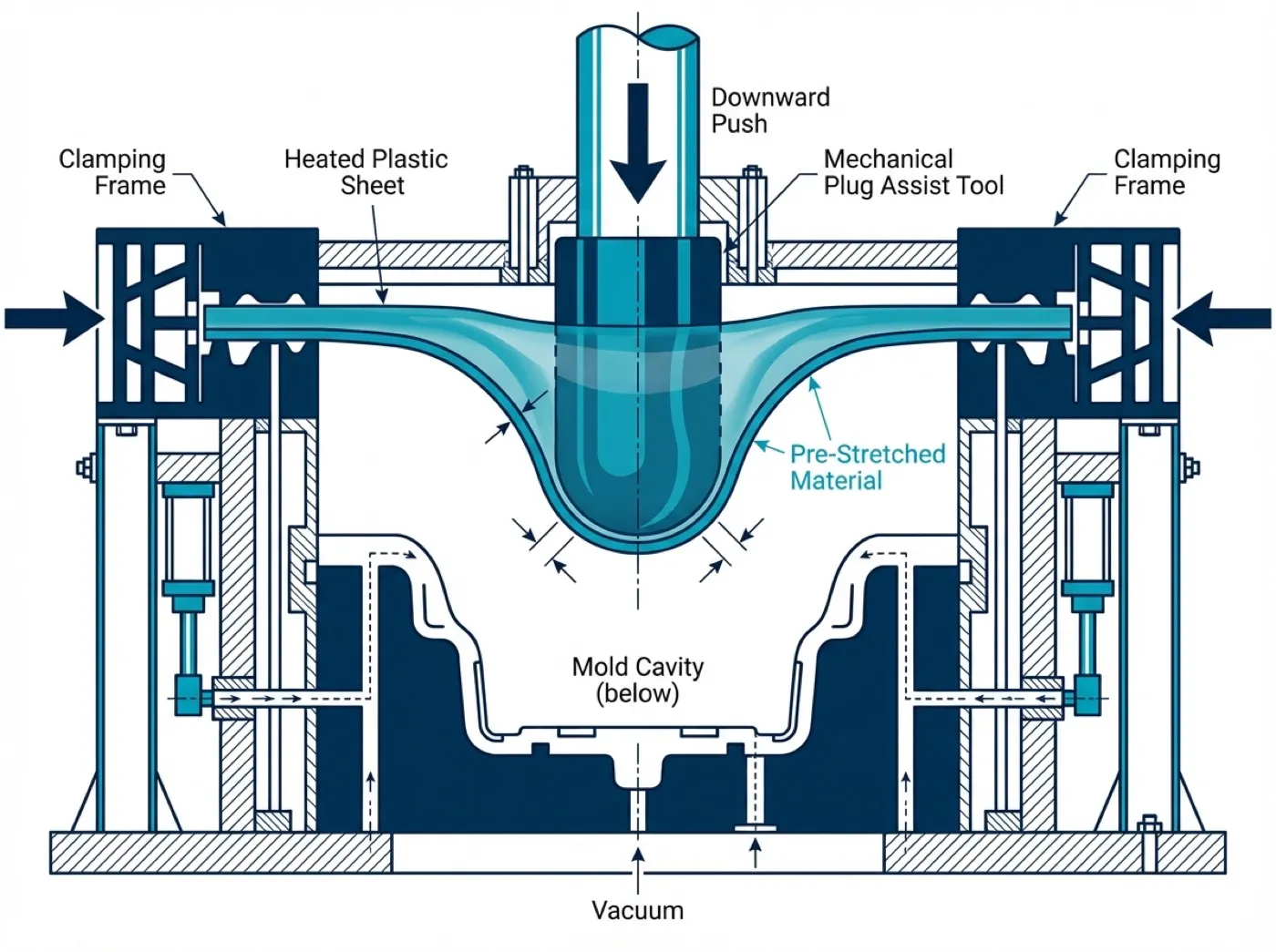
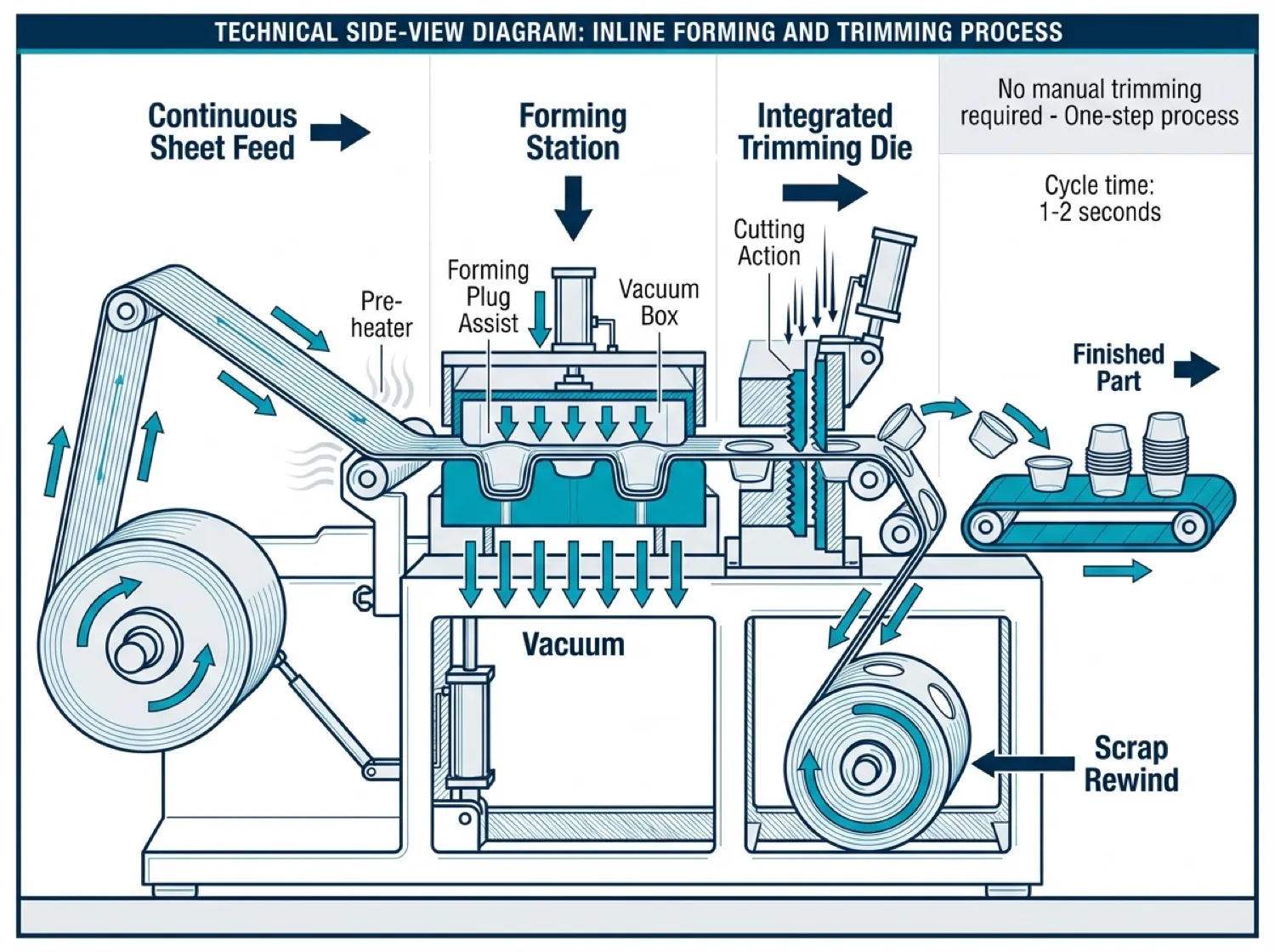
A thermoplastic sheet is clamped in a frame and heated by zoned infrared heaters until pliable. For deeper or more uniform parts it is pre-stretched — billowed with air and/or pushed by a plug — so material is distributed before it touches the tool.
A vacuum then evacuates the space between sheet and mould, and ordinary atmospheric pressure (about 1 bar) presses the sheet tightly onto the single-sided tool, reproducing its shape and surface. The part is cooled to set dimensionally, released and trimmed to net shape.
Thin gauge vs thick gauge
The same vacuum principle runs two very different ways, depending on sheet thickness and volume.
Thin gauge (≈0.1–2 mm)
Roll-fed, high-speed, multi-cavity forming with integrated trimming — thousands of parts per hour for packaging, trays, blisters, clamshells, cups and lids.
Thin gauge capability →Thick / heavy gauge (≈2–12 mm)
Cut-sheet forming of large, durable single parts — machine covers, EV and appliance panels, medical housings, liners and dunnage — that often replace metal or fibreglass.
Thick gauge capability →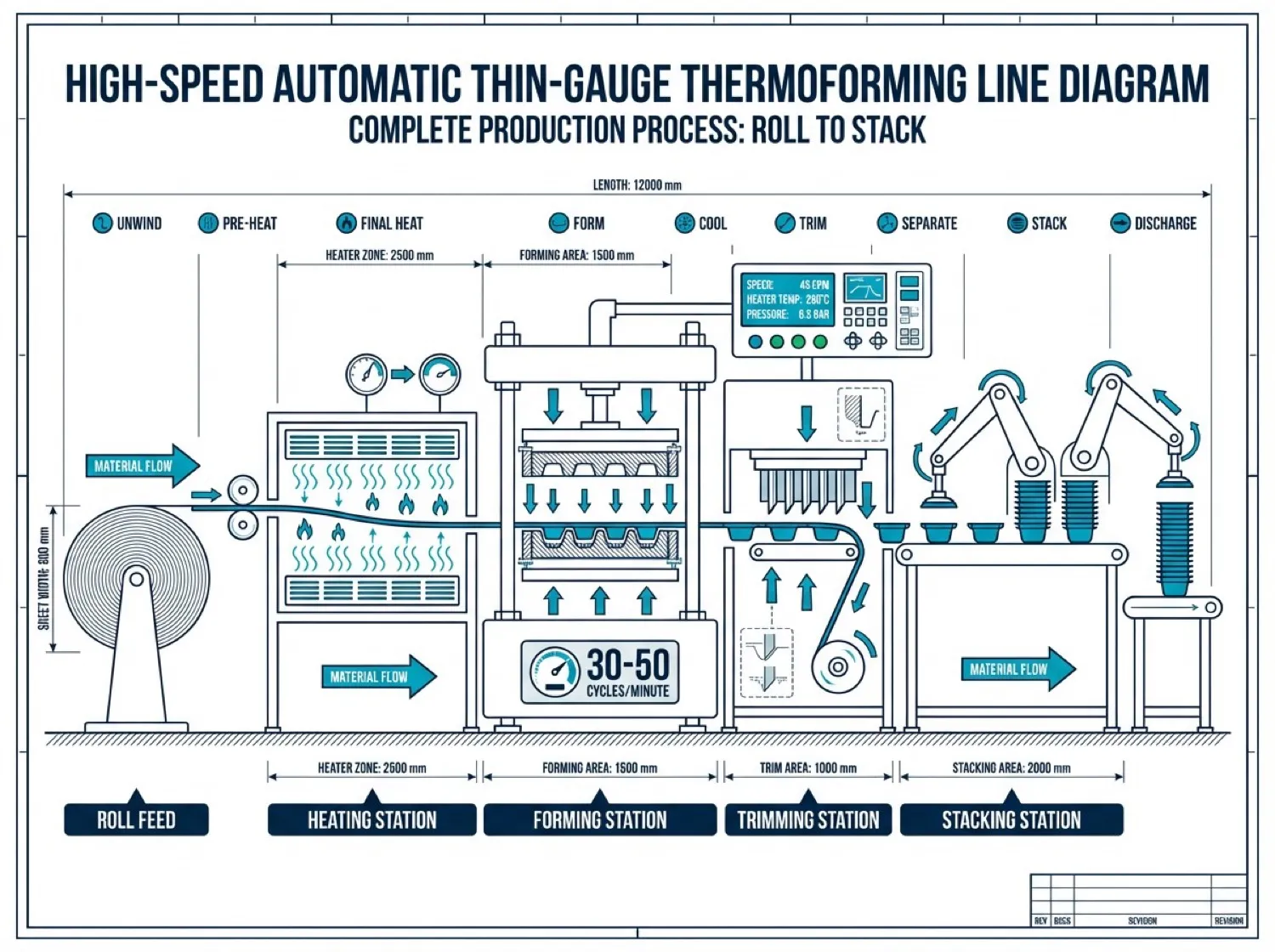
Vacuum forming vs pressure forming
Vacuum forming is the default. Step up to pressure forming when the part needs injection-mould-grade detail on the show face.
Vacuum forming
- Vacuum + atmospheric pressure only
- Lowest tooling cost & fastest route
- Covers, trays, liners, panels, packaging
- Softer detail, rounded corners
Pressure forming
- Adds several bar of positive air
- Sharp radii, texture, formed-in logos
- Undercuts & cosmetic enclosures
- Modest tooling premium
All the methods side by side on types of thermoforming.
Vacuum forming vs injection moulding
Neither wins outright — each dominates a region of the size / volume / detail map.
Typical industry guidance, not fixed specifications — the crossover depends on part size, volume and detail.
What to build with vacuum forming
If it is a single-wall part made from a plastic sheet, vacuum forming is usually the most economical way to make it.
Machine covers & enclosures
Large one-piece covers and equipment housings that replace sheet metal and fibreglass at a fraction of the cost.
Appliance & refrigerator liners
Deep-drawn inner liners, door panels and white-goods components in food-safe HIPS and ABS.
Trays, dunnage & handling
Cavity trays and returnable dunnage for electronics, automotive, medical and industrial parts.
Packaging (thin gauge)
High-volume blisters, clamshells, cups, lids and food trays run roll-fed at speed.
Automotive & EV panels
Interior trims, cladding, battery covers and body panels — light, durable, tool-light.
Point of sale & signage
Embossed sign faces, displays and brand elements formed from single sheets.
Browse finished work in the product library →
Have a part to vacuum form?
Send the drawing — our engineers reply with material, tooling approach and a costed quote.
Designing a vacuum-formed part
Draw ratio, radii, draft and tool type decide whether a part forms with even walls and releases cleanly. The values below are typical starting points — we confirm the safe numbers for your material, gauge and geometry.
Draw ratio & wall distribution
A formed part has more surface area than the flat sheet — the draw ratio between them determines how thin the walls get. High draw-ratio parts thin at the base and corners; we manage it with pre-blow, plug assists and zoned heating, and model the wall distribution before tooling.
Depth of draw
Vacuum forming is happiest at moderate depth-to-width ratios. For deep parts a plug assist (or pre-blow) pre-stretches the sheet so the base does not thin excessively — the practical route to deep, even-walled parts.
Radii & corners
Avoid sharp internal corners; they thin and weaken the part. Inside radii of at least the sheet thickness work as a starting point, increasing with cavity depth. Generous radii also improve wall distribution.
Draft angles
Vacuum-formed walls need draft to release — a few degrees per side as a guide, and more on textured tools. Male (positive) tools generally need more draft than female (cavity) tools of the same depth.
Male vs female tooling
Male tools control the inside dimension and give thicker rims; female cavities control the outside dimension and suit parts nested close together or with detail on the outer face. We advise which suits your part.
Wall thickness & starting gauge
Finished wall thickness is always less than the starting sheet because the material stretches. Starting gauge is chosen so the thinnest area still meets strength and stiffness needs.
Send us the part early
A drawing or STEP file at concept stage lets our engineers flag draw-ratio, radius and draft issues before tooling is cut — the cheapest time to fix them.
Request a DFM review →Draft, wall-thickness and tolerance detail for all processes is in the thermoforming design guide.
Materials & gauge
Almost any thermoplastic can be vacuum formed, from 0.2 mm packaging film to 12 mm structural sheet. Because Indu extrudes its own sheet, grade, colour, texture and thickness are controlled from the pellet — including FR, ESD, UV-stable, food-grade and recycled grades.
ABS & ABS blends
Tough, stiff, easy to form and finish — covers, housings, panels and trim; FR and UV grades available.
HIPS
Economical and food-safe grades, easy to print — packaging, liners, POS and disposables.
PET / APET / RPET
Glass-clear, food-contact, recyclable and recycled-content — blisters, clamshells and food trays.
PP
Chemical, fatigue and heat resistance, living-hinge and barrier options — meal trays and reusable parts.
PC & PC-FR
High impact and heat resistance, UL 94 V-0 — EV battery covers, guards and electrical parts.
HDPE
Outdoor durability and chemical resistance — dunnage, tanks, covers and agriculture.
PMMA-ABS / ASA
UV-stable, weatherable, premium gloss — sanitary ware, cladding and appliance fascias.
PVC / PLA / TPO
Legacy clarity, compostable bio-grades and soft-touch/flexible options for specialist uses.
Full grade data and datasheets on the materials & grades page.
Tooling
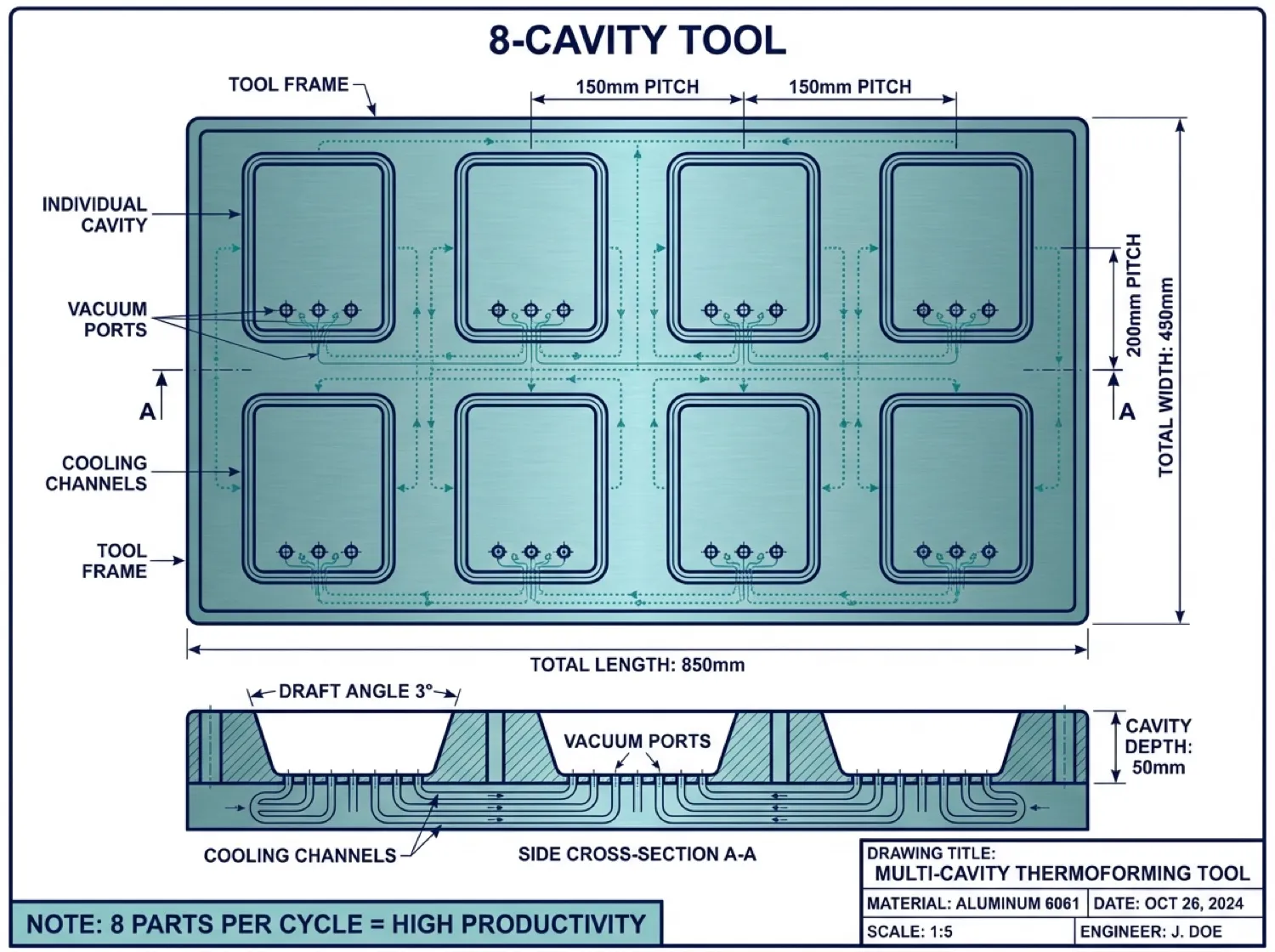
Vacuum forming uses single-sided tooling, which is why it is so much cheaper and faster than injection moulding. We design and cut it in-house on 5-axis CNC.
- Aluminium (production)
- Machined or cast, temperature-controlled for consistent, low-warpage parts and long production runs.
- MDF, epoxy & FRP (prototype / short run)
- Fast, low-cost tools to prove the design and produce short runs, easily modified before committing to aluminium.
- Male vs female
- Male (positive) tools control inside dimensions; female cavities control outside dimensions and nest parts closely. We recommend the right one per part.
Equipment & finishing
Consistent heating and clean trimming are what separate a good vacuum-formed part from a warped or ragged one. We keep every step in-house.
- Zoned infrared heating. Independent heater zones bring the whole sheet to an even forming temperature with sag control.
- 5-axis CNC trimming. Parts are trimmed to net shape against part datums for clean, repeatable edges and holes.
- Secondary operations. Drilling, painting, screen printing, EMI/RFI shielding, insulation bonding and assembly.
- Recycling. Skeletal offcuts are reground and re-extruded; recycled-content and bio grades available.
Tolerances & why it matters who forms it
Tolerances
Vacuum-formed parts are made to ISO 2768 — coarse class (c) as standard, with tighter tolerances agreed on critical, CNC-trimmed and datum-referenced features. Uniform walls come from pre-stretch, plug assists and sag control; repeatable dimensions come from temperature-controlled tooling and datum-referenced trimming. We agree the tolerance scheme on your drawing before tooling.
The Indu advantage
- We extrude our own sheet — grade, colour, texture, FR/ESD/food from the pellet
- The largest thermoforming bed in India for very large parts
- In-house tooling on 5-axis CNC, thin & thick gauge under one roof
- Recycled and bio grades specified and certified directly
- ISO 9001, with in-house trimming, finishing & assembly
Is vacuum forming the right process?
A 30-second gut-check before you send a drawing. When it fits, vacuum forming is faster and far cheaper to tool; when it doesn't, we'll tell you.
A strong fit when you have…
- Large or oversized parts
- Low-to-medium annual volumes
- First parts needed in weeks, not months
- Replacing metal or fibreglass
- Styling still changing between batches
- Single-wall covers, trays, panels & housings
Injection moulding may win when…
- Very high annual volumes
- Small, thick, highly detailed parts
- Solid sections, ribs, bosses or threads
- Sharp detail needed on both faces
Not sure which side you're on? That's exactly the DFM call we make for free.
Cost and volume shown as typical bands — the exact crossover depends on part size, geometry and volume.
Vacuum forming FAQ
How does vacuum forming work?
A thermoplastic sheet is clamped, heated until pliable, then a vacuum evacuates the space between the sheet and a single-sided mould so atmospheric pressure (about 1 bar) presses the sheet onto the tool, reproducing its shape. The part is cooled to set, then trimmed to net shape.
What is the difference between thin gauge and thick gauge vacuum forming?
Thin gauge uses roll-fed sheet from about 0.1–2 mm for high-speed packaging, trays and blisters. Thick (heavy) gauge uses cut sheet from about 2–12 mm for large, durable structural parts such as covers, panels, enclosures and liners.
Vacuum forming vs pressure forming — which do I need?
Vacuum forming is the most economical option for covers, trays, liners and simple panels. Pressure forming adds compressed air for sharper radii, formed-in texture, logos and undercuts — choose it when the part must look injection-moulded on the show face.
How accurate is vacuum forming?
Parts are made to ISO 2768 — coarse class (c) as standard, with tighter tolerances agreed on critical, CNC-trimmed and datum-referenced features. Wall thickness is kept uniform with pre-stretch, plug assists and sag control.
What materials can be vacuum formed?
Most thermoplastics: ABS, HIPS, PET/PETG/RPET, PP, PC (including FR), HDPE, PMMA-ABS, ASA, PVC and PLA. Because Indu extrudes its own sheet, grade, colour, texture, thickness and FR/ESD/food-grade properties are controlled from the pellet.
How much does vacuum forming tooling cost?
Typically a fraction of an equivalent injection mould, with first samples usually in a few weeks. Aluminium tooling suits production; MDF, epoxy and FRP tools are used for prototypes and short runs — all designed and cut in-house.
Vacuum forming quote
Have a part to vacuum form?
Send a drawing, STEP file or sample — our engineers reply with material, tooling approach and a costed vacuum forming quote, usually within 24 hours.
ISO 9001:2015 certified · Most quotes back within 24 hours