

The complete guide
The complete guide to pressure forming
Pressure forming produces parts with crisper detail and sharper features than conventional vacuum forming — in fact it rivals injection moulding for surface cosmetics, at a fraction of the tooling cost. This guide covers how it works, how it compares with vacuum forming and injection moulding, what to build with it, and the design, material, tooling and finishing detail engineers need to specify a part correctly.
Vacuum plus compressed air
Pressure forming starts like vacuum forming: a thermoplastic sheet is clamped, heated to its forming temperature and drawn onto a mould by vacuum. Then a sealed pressure box over the sheet adds positive compressed air on the back of the part, pressing the softened plastic into the tool many times harder than vacuum can alone.
That extra force is the whole point. It pushes the sheet into every corner, texture and engraved detail of the mould — producing sharp radii, formed-in logos, grained finishes and undercuts on the show face, with a surface quality close to injection moulding.
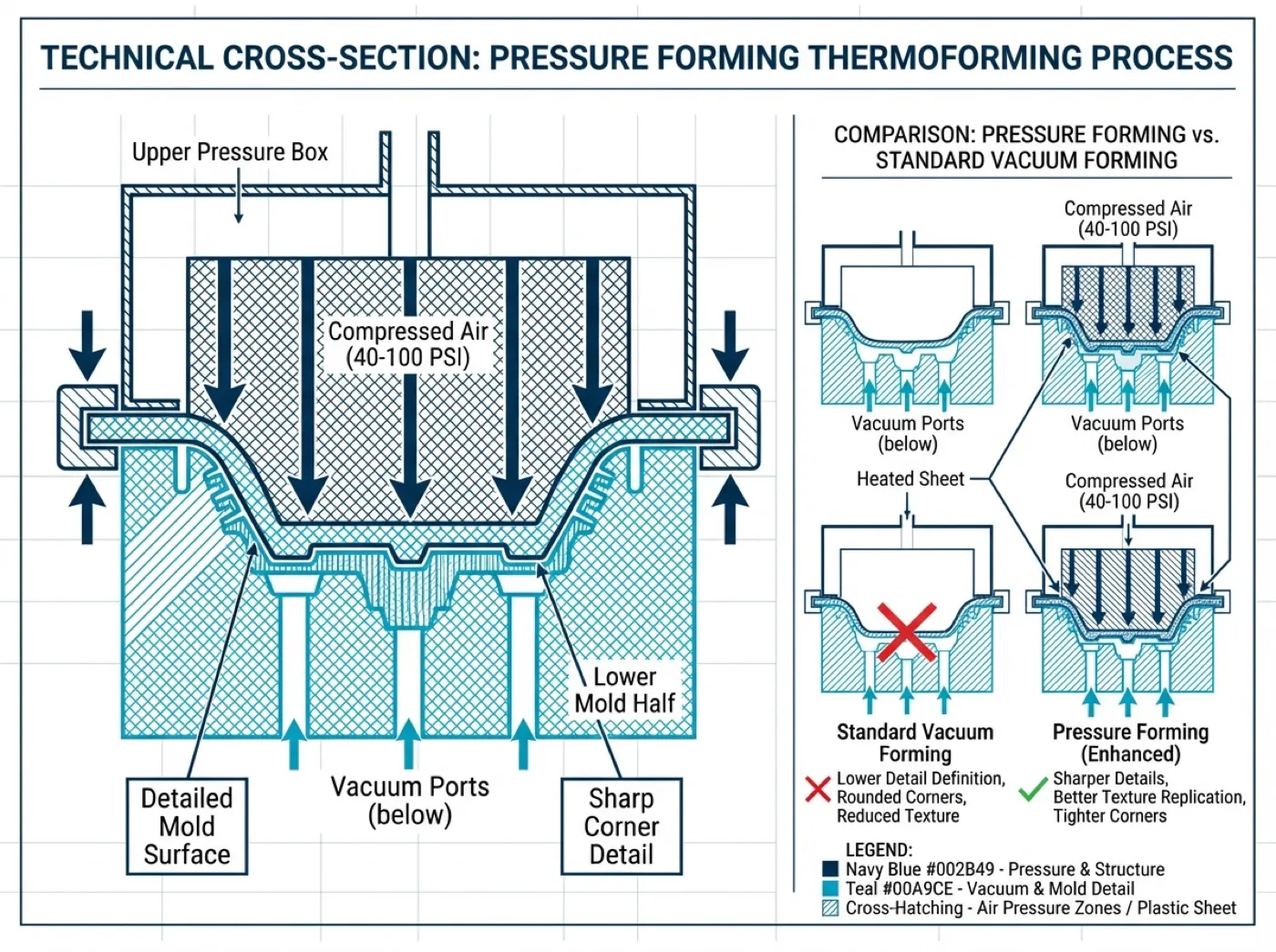
Pressure forming vs vacuum forming
Same starting point, more forming force. Choose pressure forming when the extra force buys detail the part actually needs.
Vacuum forming
- Atmospheric pressure only (~1 bar)
- Softer detail, rounded corners
- Lowest tooling cost
- Covers, trays, liners, simple panels
Pressure forming
- Adds several bar of positive air
- Sharp radii, texture, formed-in logos
- Undercuts & tighter styling lines
- Cosmetic bezels, housings, fascias
See all the methods side by side on types of thermoforming.
Pressure forming vs injection moulding
The comparison that decides most projects. Pressure forming wins on cost, speed and size; injection moulding wins on volume and two-sided detail.
Figures are typical industry guidance, not fixed specifications — the crossover depends on part size, volume and detail.
What to build with pressure forming
Use it when the part is the "face" of the product — where crisp detail, sharp corners and surface cosmetics on one side matter, in a light, durable part.
Bezels & display fronts
Housings and bezels for touch-screens, control panels, instruments and displays — with formed-in logos, model text and texture on the show face.
Exterior & instrument panels
Rugged, attractive control and fascia panels with precise openings for gauges, switches, ports and connectors.
3D housings & enclosures
Covers for business, medical, diagnostic, electrical and industrial equipment with significant depth of draw.
Doors, hatches & covers
User-facing movable panels with crisp detail and consistent cut-outs for hinges, latches, handles and hardware.
Panels with undercuts & returns
Inverted lips, recessed sidewall features and wrap-back sections that conventional vacuum forming cannot produce.
Cosmetic EV & appliance parts
Textured, colour-matched exterior panels and fascias where appearance sells the product — no painting step required.
Add features on the backside, too
The show face carries the detail; the back can take EMI/RFI shielding (applied in a secondary operation), thermal or acoustic insulation, bonded bosses, brackets and stiffeners — so the finished part does more than look good.
Not sure pressure forming suits your part?
Send the drawing — our engineers confirm the process, material and tooling before you commit.
Designing a pressure-formed part
Get these right and the part forms cleanly, releases from the tool and holds its cosmetics. The values below are typical starting points — we confirm the safe numbers for your material, gauge and geometry.
Draw ratio & wall distribution
A formed part has more surface area than the flat sheet it starts from — the ratio between them (the draw ratio) drives how thin the walls become. Deep or high draw-ratio parts thin out at the base and corners unless material is redistributed. We manage it with pre-blow, plug assists and zoned heating; share the part and we model wall distribution up front.
Depth of draw
Pressure forming (with plug assist) reaches deeper draws than vacuum alone while keeping walls even. Deep female cavities need generous radii and draft — the deeper the draw, the larger the minimum corner radius.
Corner & edge radii
Sharper than vacuum forming, but not zero. As a guideline, inside radii of roughly the sheet thickness work on shallow features, increasing with cavity depth; very tight radii thin and weaken the material. We advise the safe minimum for your gauge and depth.
Draft angles
Enough draft is needed to release the part cleanly — especially from textured tools, where more texture depth needs more draft (a common rule of thumb is ~1.5° of draft for every 0.001″ of texture depth). Female cavities still need release draft.
Undercuts & returns
Achievable with moving tool sections and inserts — kept modest and sized to the part; heavier gauges tolerate larger undercuts. Design them in and we confirm what the tool can release.
Texture, styling lines & vacuum holes
Grain patterns with connecting channels let trapped air escape for crisp texture; styling lines add rigidity and hide flat-panel oil-canning; vacuum-hole size and placement are set to evacuate air without marking the show face.
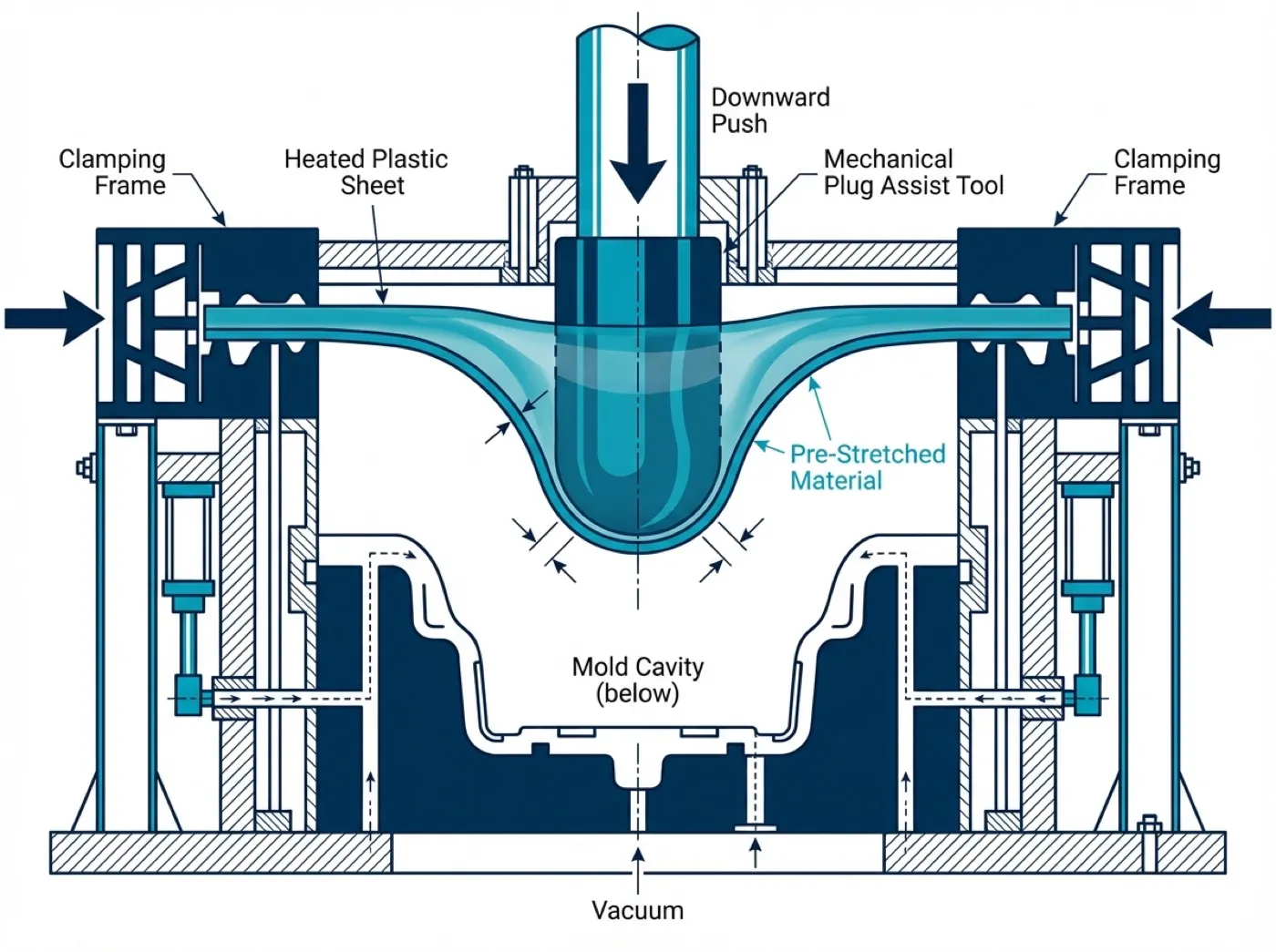
Send us the part early
A drawing or STEP file at concept stage lets our engineers flag draw-ratio, radius and draft issues before tooling is cut — the cheapest time to fix them.
Request a DFM review →For draft, wall-thickness and tolerance detail across all processes, see the thermoforming design guide.
Materials & gauge
Most engineering thermoplastics can be pressure formed. Standard parts run roughly 1.5–6 mm sheet (thinner and thicker are possible); because Indu extrudes its own sheet, grade, colour, texture and FR/ESD properties are set from the pellet.
ABS & ABS blends
The workhorse — tough, easy to form and finish, takes texture and paint well; FR and platable grades available.
ABS-PMMA (acrylic-capped)
Hard, UV-stable, high-gloss show surface — premium enclosures, sanitary and EV exteriors.
ASA
Weatherable and colour-stable for outdoor and exterior cosmetic panels.
Polycarbonate & PC-FR
High impact and heat resistance, UL 94 V-0 grades — equipment guards, medical and electrical housings.
HIPS
Economical, easy to print and texture — covers, liners and internal panels.
PETG & copolyester
Clear, tough, food-contact — bezels and transparent covers.
TPO / PVC alloys (FR)
Flame-rated and soft-touch options for transit, rail and specialist enclosures.
ESD / conductive grades
Static-safe housings and trays for electronics and cleanroom equipment.
Full grade data and datasheets on the materials & grades page.
Tooling
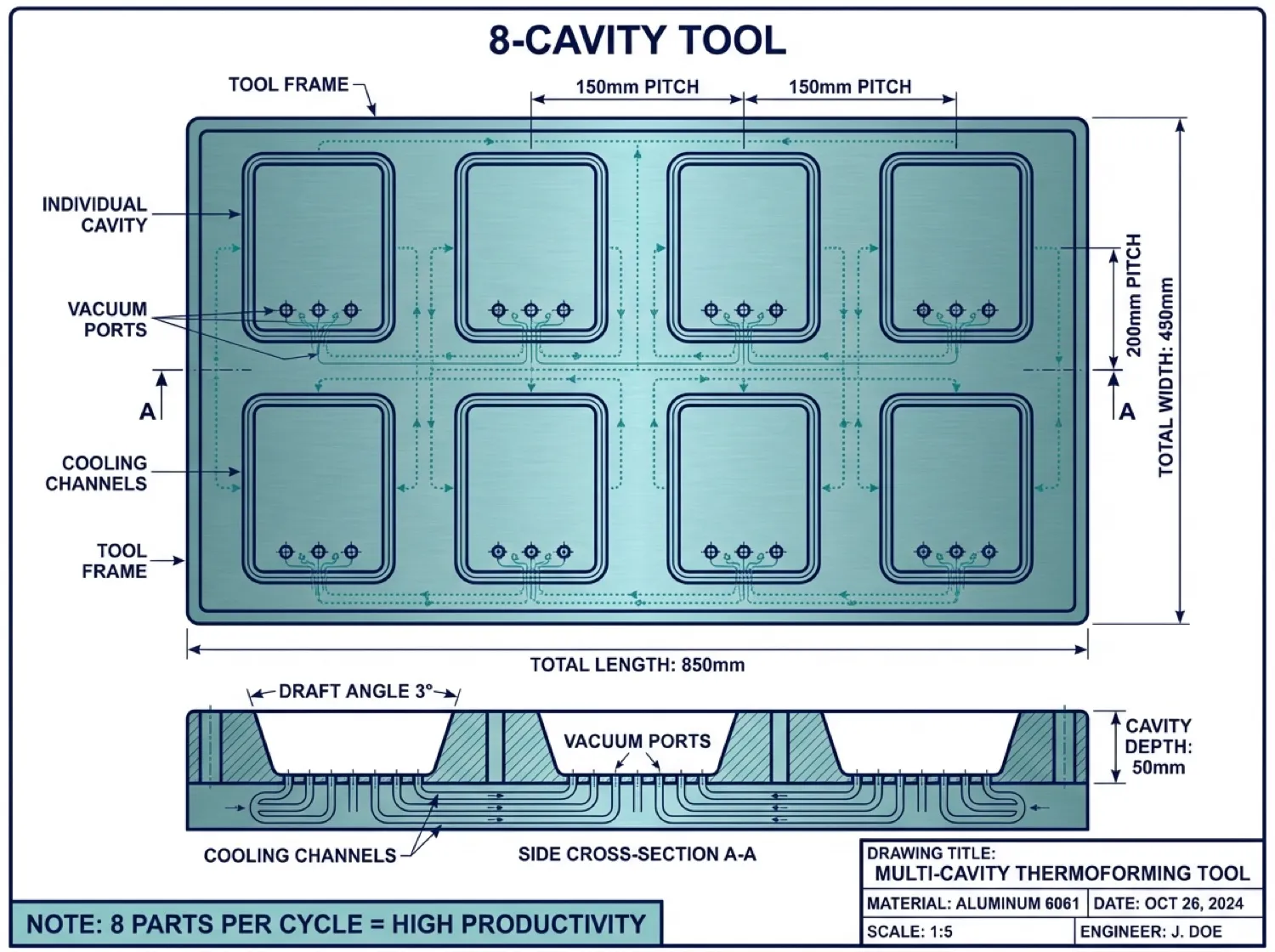
Tooling is the single biggest factor in a quality pressure-formed part. We design and cut it in-house on 5-axis CNC.
- Machined aluminium (temperature-controlled)
- The gold standard for pressure forming — best detail and texture definition, water-cooled for tight, repeatable, low-warpage parts.
- Cast aluminium
- A lower-cost alternative; needs liberal vacuum holes and, due to some porosity, suits less demanding textures.
- Epoxy / composite (prototype)
- Affordable for prototypes and very short runs and easy to modify — used to prove the design before committing to production tooling.
Equipment & process control
Pressure forming needs more capable machinery than plain vacuum forming — and tight process control is what makes parts repeatable.
- Rigid platens & sealed pressure box. High clamp force holds the tool and pressure box closed against several bar of forming air.
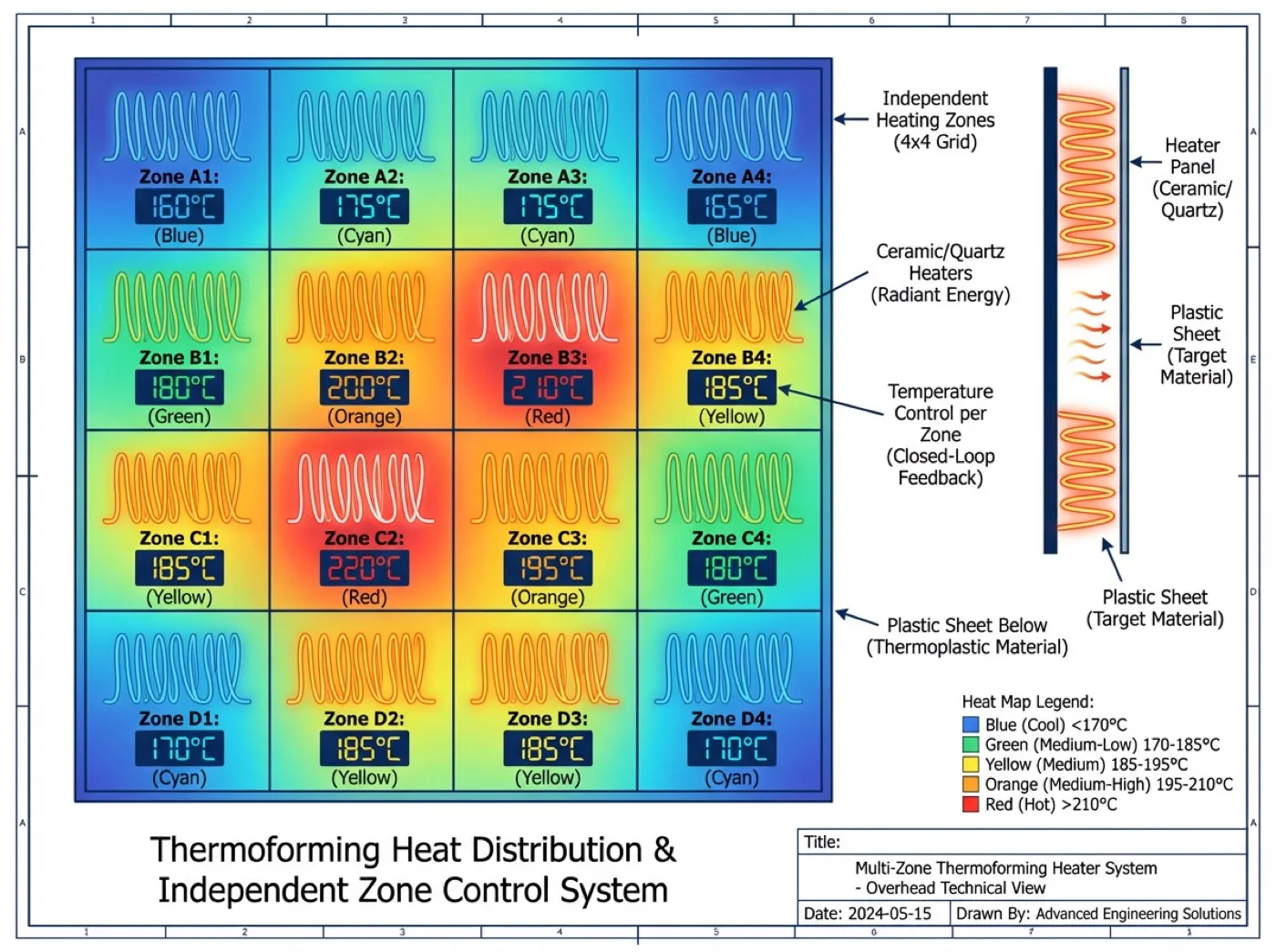
- Zoned infrared heating. Independent heater zones bring the whole sheet to an even forming temperature — the foundation of consistent walls and detail.
- Controlled air & cooling. Forming-air and cooling airflow tuned to the material, gauge and ambient conditions for the right set rate.
- Repeatable cycles. Each stage repeats to within a few seconds, run to run, for dimensional consistency.
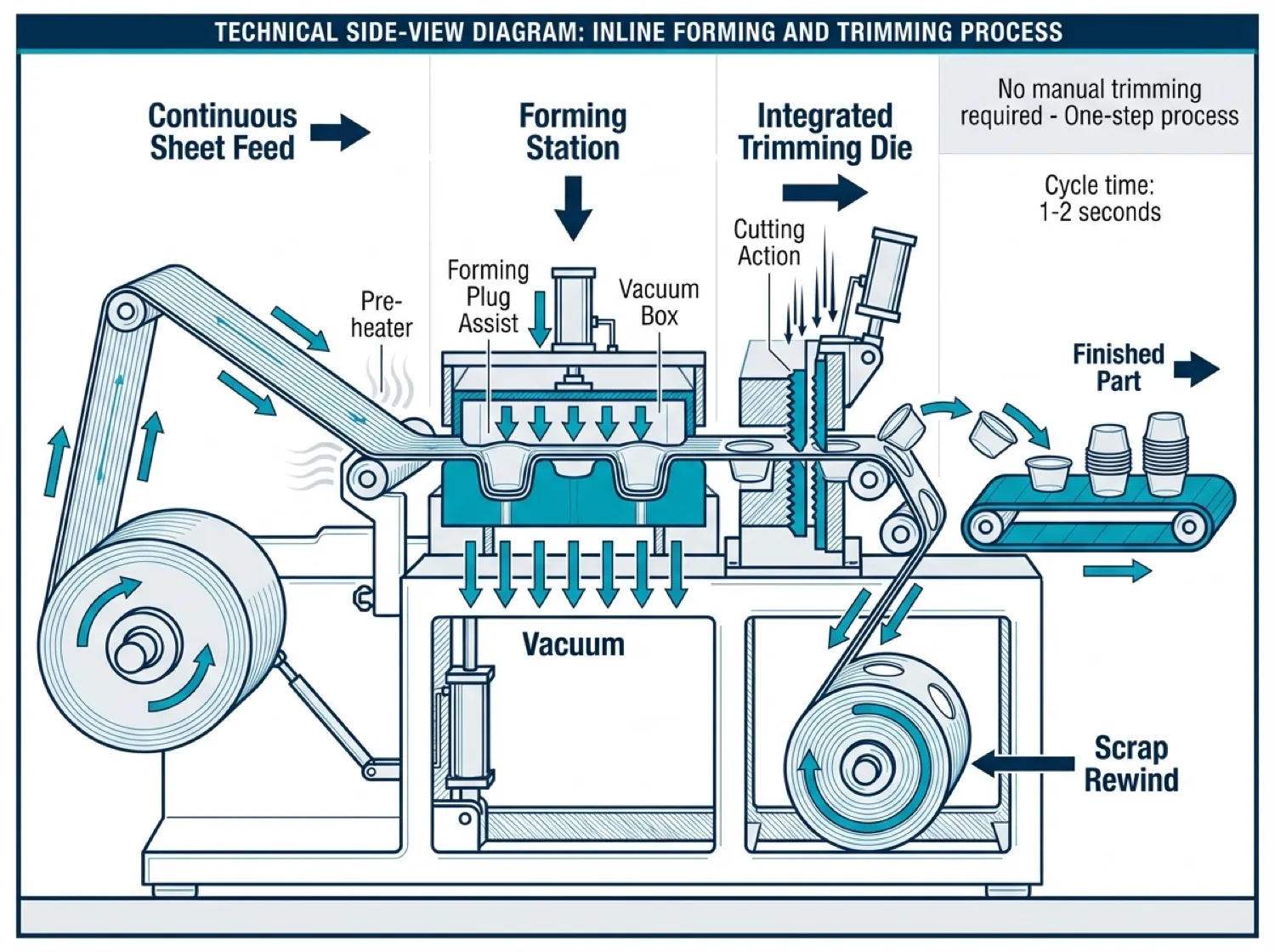
Trimming & finishing
A pressure-formed part is rarely finished at the press. Doing the secondary work in-house keeps cost, quality and lead time under one roof.
Tolerances & why it matters who forms it
Tolerances
Pressure-formed parts are made to ISO 2768 — coarse class (c) as standard, with fine class (f) achievable on critical, CNC-trimmed and datum-referenced features — typically the mounting and interface points on cosmetic parts. Temperature-controlled aluminium tooling and datum-referenced trimming are what make the tighter numbers repeatable. We agree the tolerance scheme on your drawing before tooling.
The Indu advantage
- We extrude our own sheet — grade, colour, texture, FR/ESD set from the pellet
- The largest thermoforming bed in India for large cosmetic panels
- In-house aluminium tooling on 5-axis CNC
- Colour-matched to Pantone / RAL — often no painting step
- ISO 9001, with in-house trimming, finishing & assembly
Is pressure forming the right process?
A 30-second gut-check before you send a drawing. When it fits, pressure forming is faster and far cheaper to tool; when it doesn't, we'll tell you.
A strong fit when you have…
- Large or oversized parts
- Low-to-medium annual volumes
- First parts needed in weeks, not months
- Replacing metal or fibreglass
- Styling still changing between batches
- Single-wall covers, trays, panels & housings
Injection moulding may win when…
- Very high annual volumes
- Small, thick, highly detailed parts
- Solid sections, ribs, bosses or threads
- Sharp detail needed on both faces
Not sure which side you're on? That's exactly the DFM call we make for free.
Cost and volume shown as typical bands — the exact crossover depends on part size, geometry and volume.
Pressure forming FAQ
How much air pressure does pressure forming use?
Pressure forming applies positive air pressure to the back of the heated sheet — typically several bar (roughly 30–75 psi, and higher on some tools), many times the force of the atmospheric pressure that drives plain vacuum forming. That extra force is what captures sharp detail, texture and tight radii. Exact pressure depends on the material, gauge and tool.
What is the difference between pressure forming and vacuum forming?
Both heat a sheet and draw it onto a mould with vacuum. Pressure forming adds positive compressed air behind the sheet, pressing it into the tool far harder — giving sharper radii, formed-in textures and logos, and undercuts that vacuum forming alone cannot achieve. Vacuum forming is more economical for covers, trays and simple panels.
When should I choose pressure forming over injection moulding?
For low-to-medium volumes of cosmetic parts — bezels, housings, fascias, panels — pressure forming delivers a comparable show-face appearance with tooling at a fraction of injection cost and first parts in weeks instead of months. Injection moulding wins for very high volumes and small, thick, detailed-on-both-sides parts.
How accurate is pressure forming?
Parts are made to ISO 2768 — coarse class (c) as standard, with fine class (f) achievable on critical, CNC-trimmed and datum-referenced features, which is often where pressure-formed cosmetic parts need precision. We agree the tolerance scheme against your drawing before tooling.
What materials can be pressure formed?
Most engineering thermoplastics: ABS and ABS blends, ABS-PMMA, ASA, polycarbonate (including FR), HIPS, PETG, TPO, FR PVC alloys and ESD grades. Because Indu extrudes its own sheet, grade, colour, texture, thickness and FR/ESD properties are controlled from the pellet.
Can logos and textures be formed into the part?
Yes — logos, model designations, styling lines and grained or textured finishes are formed directly into the show face from the tool, with detail approaching injection moulding. Colour is in the resin, so many parts need no painting.
Pressure forming quote
Have a cosmetic part to pressure form?
Send a drawing, STEP file or sample — our engineers confirm whether pressure forming suits the part and reply with material, tooling approach and a costed quote, usually within 24 hours.
ISO 9001:2015 certified · Most quotes back within 24 hours